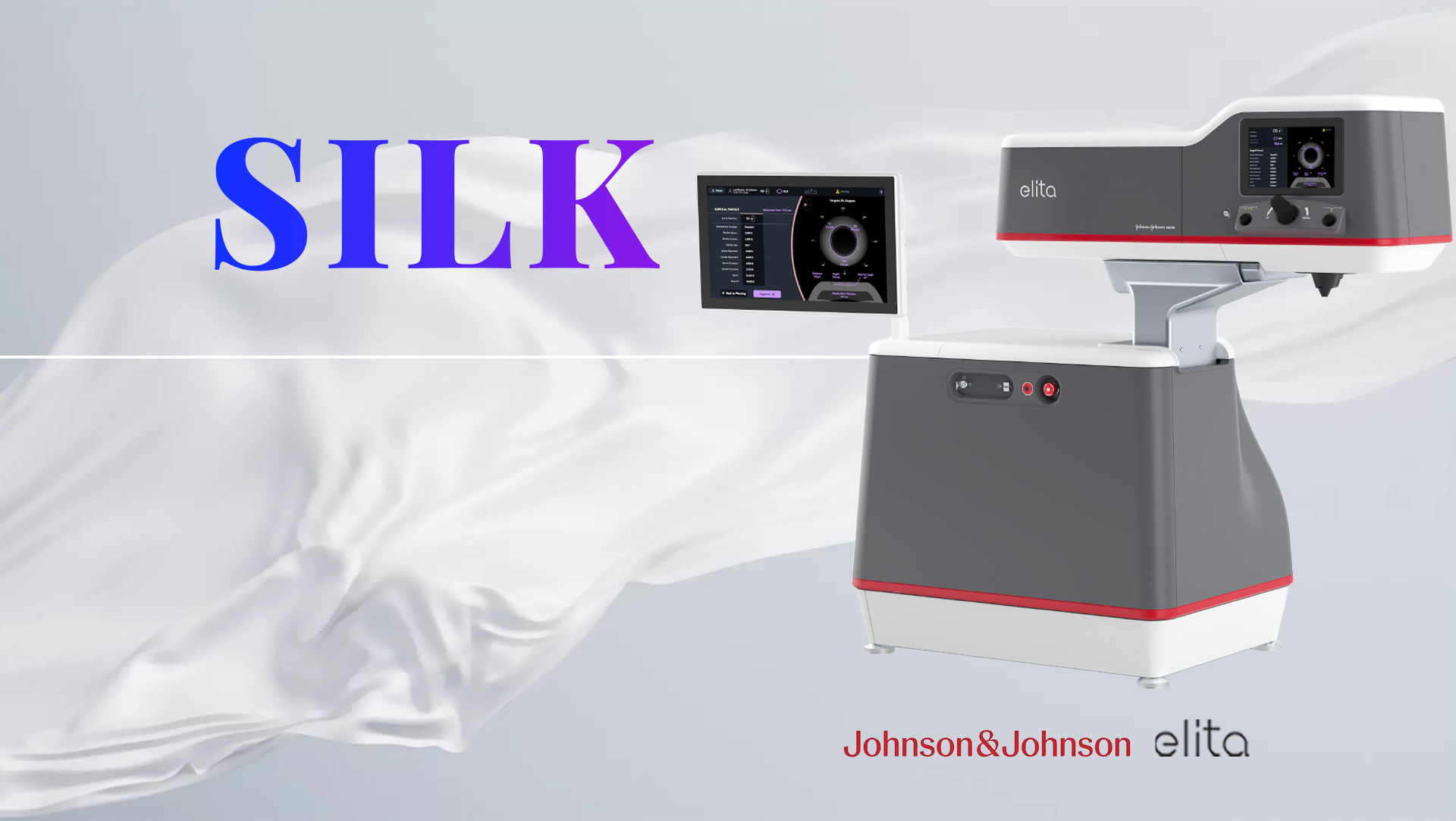
Smooth Incision Lenticular Keratomileusis
Experience highly refined vision correction
with SILK, powered by the
Johnson &Johnson Vision
ELITA™ laser—delivering silk-smooth
precision through ultra-low energy pulses.

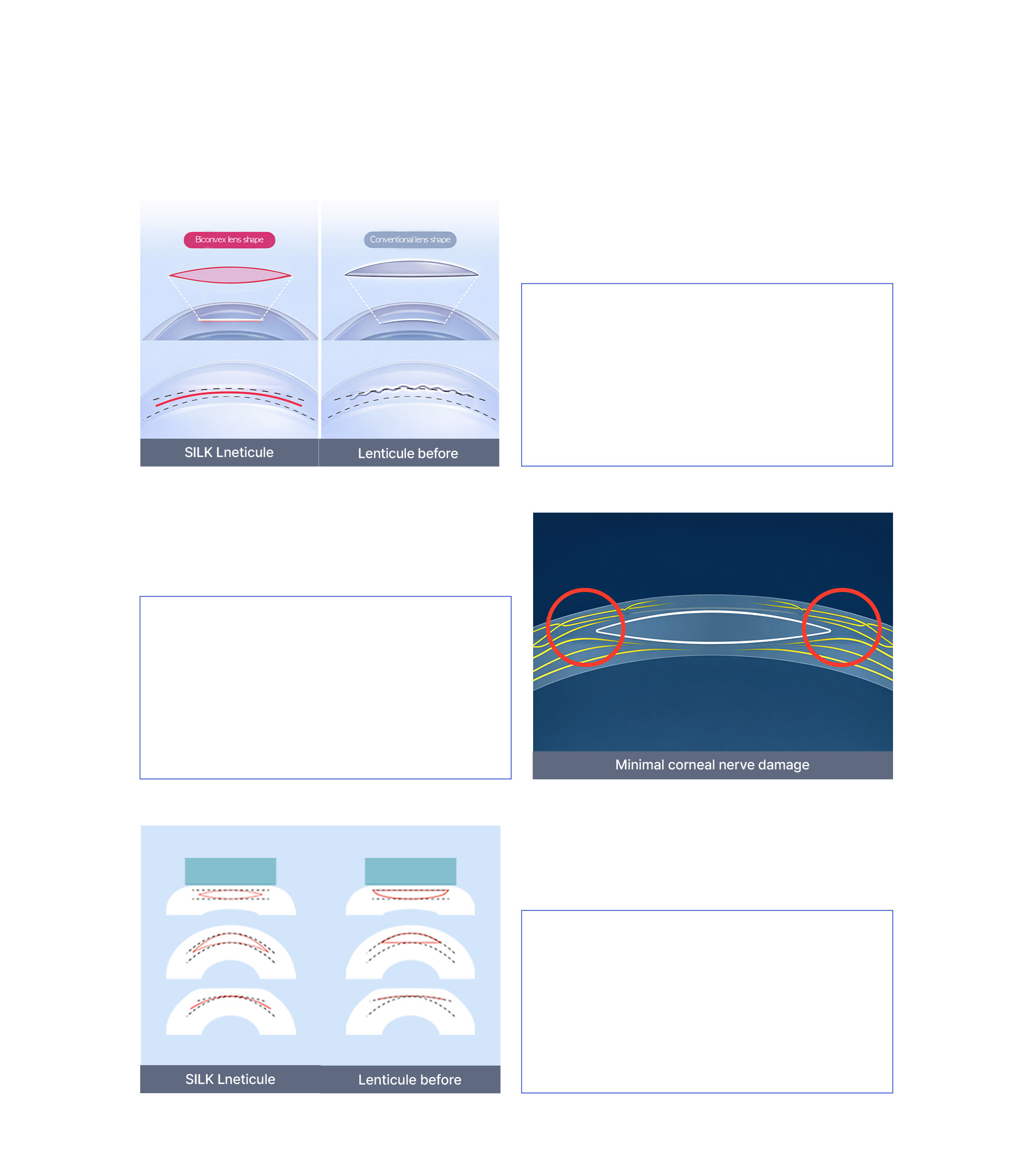
Bi-Convex Lenticule
Bi-convex (Double-Convex) Lenticule
Clear Vision / Reduced Glare
Matching anterior and posterior lenticule curvatures
minimize corneal wrinkling, ensuring a smoother
interface and more consistent,
high-quality visual recovery
Reduced Risk of Dry Eye
Unlike conventional lenticules, the lenticule is formed
deeper in the posterior corneal layer, minimizing
damage to corneal nerves. This allows faster nerve
regeneration and lowers the incidence
of dry eye symptoms
Preservation of Corneal Strength
The symmetrical front and back surfaces
of the lenticule help maintain corneal biomechanics and
contribute to preserving corneal optical quality, which
reduces halos and light scatter

An extra suction fixation ring is
added between the eye and
the suction lens
In conventional procedures, the suction lens attaches directly
to the eye, creating a risk of suction loss during laser
application or inaccuracies from minor eye movement.
SILK surgery adds a separate suction ring to stabilize the eye,
ensuring more secure and consistent fixation

Visual Axis and
Astigmatism Axis Alignment
in Silk Surgery
Centering / Astigmatism Axis Correction
After docking, the central axis and astigmatism rotational axis
are reset to prevent visual axis deviation and
astigmatism axis errors.
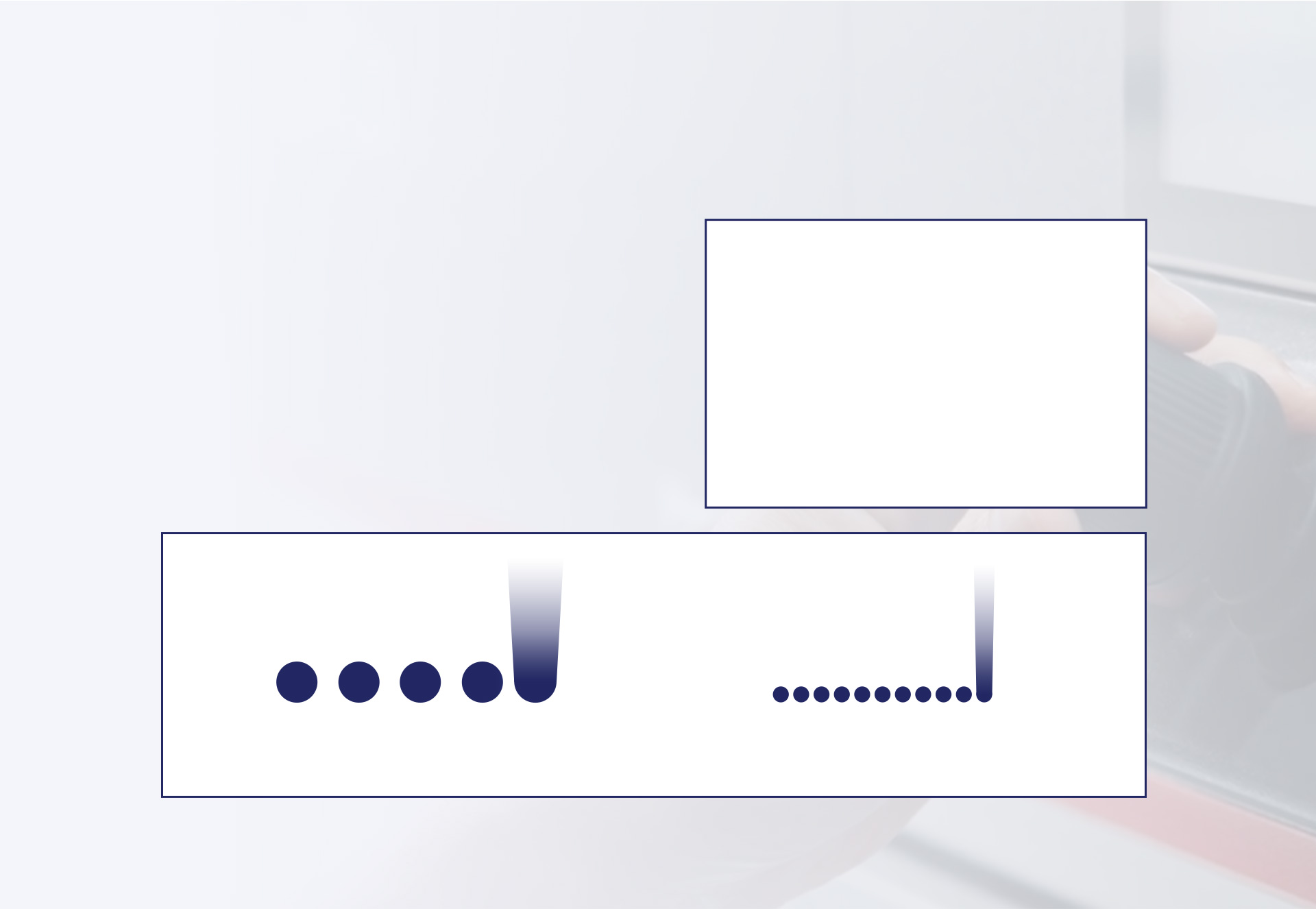
1μm Ultra-Micro Laser Spots
with Low-Energy Pulses
ELITA (SILK) uses an average laser spot
spacing of 1μm, minimizing tissue bridges
and cavitation bubbles after cutting.
This produces a smoother, more uniform
corneal lenticule interface,
delivering higher visual quality
Conventional Laser Spots
High laser energy increases the risk of surrounding tissue
damage and results in a rougher incision surface
SILK LASIK Laser Spots
Low laser energy reduces surrounding tissue damage
and creates a smoother incision surface
SILK LASIK Q&A
Frequently Asked Questions About SILK LASIK
From anesthetic eye drops and precautions during surgery to whether you can close your eyes
check everything at once in this video.

Solution 01
AcuTarget visual axis analysis
AcuTarget SMILE
Next generation laser vision correction surgery with amazing recovery speed and excellent safety
Corneal center No.! Pupil Center No.!
Correction with more precise Purkinje center (Optical Zone Center)
AcuTarget is a visual axis analysis device, and in JOEUNNUN VISION CLINIC, you can obtain higher quality vision by performing SMILE surgery based on precise visual axis analysis using AcuTarget.

Solution 02
Next generation vision correction surgery using Avedro KXL system
Prevents the cornea weakening in SMILE surgery
Strengthens the cornea with collagen cross-linking
Riboflavin (vitamin B2) solution is applied to the site where the lenticle has been removed.
Riboflavin solution is absorbed into corneal tissue.
Ultraviolet A(UVA) is irradiated on the cornea for approximately 30~60 seconds.
With the increase of cross-linking in the collagen fiber, the corneal strength is restored again.
Corneal cross linking using the Avedro KXL system and VibeX,a riboflavin solution, induces collagen cross-linking that com-poses the cornea, thereby increasing the strength of thecornea.

Solution 03
Personalized energy
for satisfactory surgical results
Appropriate use of energy according to the characteristics of each individual corneal tissue!
In the case of excessively large laser energy, there is a possibility of damage to the surrounding tissue. Conversely, if the energy is too low, it may lead to even severe damage to the corneal tissue due toincomplete separation of the corneal flap.
In SMILE Surgery, the cornea is separated with a Femtoseconds Lasers
If corneal separation is incomplete due to too low laser energy, this can cause damage to the surrounding cornea.
Therefore, when the appropriate energy is used for the characteristics of each individual’s corneal tissue, the separated corneal surface is the smoothest, and stable surgical results can be obtained.

Solution 04
Less postoperative side effects by reducing corneal nerve damage!
Prevention of corneal nerve damage
In LASIK and LASEK, the upper layer of the cornea is cut, which leads to damage to the nerve layer and causes sensory changes in the cornea and dry eye.
SMILE surgery has little to no corneal sensory change because the corneal nerve is less damaged.
Normal Corneal Nerve Network
SMILE Surgery
2 mm micro incision without creating a corneal flap
LASIK
Nerve damage by corneal flap making
Passes through the corneal nerve layer and creates a lenticle in the middle layer of cornea(maintains the corneal nerve)
Making the corneal flap at the surface layer where the corneal nerve passes


JOEUNNUN VISION CLINIC’s SMILE surgery watching on Youtube
Go to YouTube channel +

SAFE SYSTEM
GANGNAM JOEYNNUN VISION CLINIC’s Safety System for Presbyopic surgery
Reliable medical staff with the know -how and skills of presbyopia
Great pride in presbyopic surgery!
Medical team with various surgical cases and abundant clinical experiences.
Meticulous preparation for patient safety
Insurance coverage
Our compensation insurance covers all patients undergoing general treatment and surgery, and helps customers to receive all medical services with confidence without any worries.
Vision CLINIC that you and your family can trust and communicate lifelong
Lifelong Family Doctor
JOEUNNUN VISION CLINIC takes full responsibility with the 1:1 care system from the patient's encounter to follow-up care.
Thorough and meticulous preparation for patient safety
University hospital-grade surgical and diagnostic equipment
JOEUNNUN VISION CLINIC has various surgical and diagnostic equipment of university hospital level such as LENSAR, MEL90, Relex Smile, Z4, Avefro KXL, and VisuMax.

CLINIC Name : Gangnam JOEUNNUN VISION CLINIC
7F, 9F, Medi Tower, 107, Teheran-ro, Gangnam-gu, Seoul, Republic of Korea
Representatives : Kim Jun-heon Business Registration No : 287-69-00230
E-mail : joeunnun535@naver.com
Copyright (c) 2021 joeunnun vision clinic. All right reserved.